Sunday, October 29, 2006

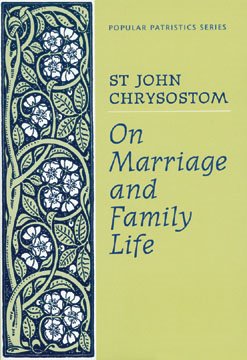
St. John Chrysostom, Mutuality and Marital Fidelity


It seems that I've started a series on John Chrysostom and family life without fully realizing it. Well, okay, I had a suspicion last week because I realized that I wanted to write about more on John's view of the family and of marriage than I had room for in a single blog entry (unless I would start a blog tome).

What I want to look at is John's Homily 19 in which he discusses a passage from 1 Corinthians 7
Now concerning the matters about which you wrote. It is well for a man not to touch a woman. But because of the temptation to immorality, each man should have his own wife and each woman her own husband.
From this starting point, John goes on to set out a sexual ethic, based on Paul's teaching in his letters which I really think we would be well to listen to in this age of ethical confusion.

What is striking about John's discussion about marital relations is the degree to which John emphasizes that one's control of our body and sexuality is no longer our own (if it ever was) when we are married. This is, of course, a sore point for many feminists who react instinctively to any suggestion that any man can tell a woman what to do with her body. And, in a sense, John fuels that reaction because he states very explicitly that the wife has not control over the body and is the slave of her husband. That certainly isn't going to play well among feminists.

Yet, if we focus only on that point, we've lost entirely John's point almost entirely. The very passage which affirms that the wife is the slave to the husband in regard to the body also makes it clear that she is his ruler. He elaborates his position by commenting that Paul speaks of conjugal rights in the terms of a mutual debt. That is, both husband's and the wife's body are not their own anymore. John's point is that, since both husband and wife no longer are sole masters over their bodies, adultery, for one thing, should be considered almost like theft:
As for you, husband, if a prostitute tries to seduce you, tell her "My body is not my own, but my wife's". And let the wife say the same to any man who is undermining her fidelity: "My body is not my own, but my husbands"
The obligation to remain faithful in body and (I think we can understand) soul is binding on male and female.

What is interesting here is that John openly admits that he is preaching an egalitarian idea here about the bodies of married people (and also, interestingly, about the money of married people). You can sense a bit of discomfort here, I think, because John recognizes that this could be taken to fly in the face of the headship image he promotes elsewhere. Yet, he closes off the possibility of the double standard enshrined in Roman divorce laws, at any rate in which a husband could divorce a wife for infidelity, but a woman generally couldn't do so on her own power.

I think John here is emphasizing here something that we in this enlightened modern age have forgotten. He emphasizes that marriage isn't a contract between autonomous individuals, but a giving of each other in service to each other in God. Sexual fidelity, I think, is only a symbol of this kind of mutual self-giving which is so essential in a marriage. In our individualism and the selfishness that comes from that, we, as a society, have tended to only ask what is in the relationship for me, me, ME! What John points out is that we are called to serve each other in marriage. If we only got that point clear, just among Christians even, I'm sure our divorce rate would plummet. From my mouth to God's ear.

Peace,
Phil

Sunday, October 22, 2006

St. John Chrysostom: Headship and the Culture Wars


I've been on a bit of a John Chrysostom kick recently, since I have, finally, got around to reading a couple collections of John's sermons from St. Vladimir Press' Popular Patristics series(an indispensable source of patristic writers for the patristic amateur). I really like St. John. John is an easy Father to get into because, ultimately, he is grounded in the nitty-gritty of Christian life and, while he clearly understands theology, he has a knack for relating it back to everyday life in a way that makes it clear that he knows where the rubber hits the road. That is, of course, because John is primarily a sermon writer, not a philosophical theologian, but it is a valuable gift and one that he liberally bestowed on the Church of his day and for the generations following.

So, yesterday, when I was contemplating this entry, I decided I would go back and have a second look at the Marriage and Family Life collection I had been reading until last week. In particular, I began to re-read his Homily 20 on Ephesians 5,22-3.

I have to admit I find that particular passage of Ephesians a bit difficult. Not so much because I have a particular problem with what Paul is actually saying, but, really, because of the memory of what people think Paul is actually saying. My experience, of course, is formed by my early intellectual formation at university during the Culture Wars of the 1980s and 90s. So my squeamishness on the subject comes from my discomfort with the polarization of the debate over the how the marital relationship should work.

On one side, we heard feminist accusations that the Bible promoted patriarchy and submission of women to men which had to be broken, if we expected to live in a free and democratic society amid gender equality and respect. Ephesians 5:22-3, in particular, was a passage feminists love to hate because Paul thought wives should be subject to their husbands and, after all, what call did any man have to demand that? Besides, they would argue, how many women were kept oppressed and abused because religious authorities connived in this abuse of women by citing this passage to support the unequivocal right of the man to rule in the household? Surely, we just have to accept that Paul was a misogynist and dismiss his talk of submission as mere patriarchal tripe.

On the other side, we heard the voice of the religious right which insisted that the headship of men over women meant that all the decisions of the Christian home should be made by the man. Women could take care of the babies, but shouldn't seek much more than that because they simply weren't cut out for it. Clearly, the headship of men was established by God because, clearly, men were best able to deal with the outside world. Women were too emotional and fragile to function outside the home, so they should be left where their nurturing talents were best employed: the Christian home. The ideal here was the 1950s middle class dream in which the father brings home the bacon and mother cooks it up for father and the kids.

I do recognize that both of these positions are caricatures. The reality of the visions of both sides of the Culture Wars was much more nuanced and varied that I present here. Yet, in the ideologically over-heated debates of that period (which continue until today) the subtleties and the nuances of each position were usually ignored and the broad lines of the debate in the media accentuated these caricatured positions (possibly because a clash of black and white ideas gives better ratings).

This line of thought brought me back to John's homily. In this homily, John can hardly be accused of being pro-feminist. Like most of the Fathers, he is not only unsympathetic with the idea of gender equality, but he is incredulous that anyone would propose it. He plainly thinks someone should take leadership in the family and that person should be the father. So, in that sense, he strongly favours the headship model of Christian marriage. On his side, of course, is that his position is strongly supported by Scripture. Time and again, in Ephesians and in other letters, Scripture makes the headship of the husband the norm in the Christian home. As John himself points out, Scripture even goes as far as making this marital headship the metaphor to describe Jesus' relationship with the Church as a whole. If this headship model wasn't intended to be binding on Christians, how could Scripture use such a metaphor for the whole Church?

I admit this is the point where I start getting uncomfortable. In the Culture Wars, if I was forced to align myself (my favoured position being sitting firmly on the fence), I would have aligned myself with the feminist view. I have few problems with seeing women work outside the home, although I worry when one or both parents are engrossed in their careers to the neglect of their children. I think very well of my wife's intelligence and ability to contribute to the world outside the home. All too often I hear the term headship and I start squirming because it all sounds too authoritarian and uncomfortable to me.

Yet John points the way out of this modern false dichotomy. Yes, he affirms that wives should be subject and obedience to their husbands. He makes it very clear that wives should show respect to their husbands, even if their husbands aren't very loving. Yet he also makes it clear that the obedience of the wife should not be the fearful obedience of a slave, but rather the response to the loving care of the husband. Just as Christ loves the Church and does everything to take care of it, so the human husband should do for his wife and family. That means a willingness to take the actions of love whenever they arise, even if one's wife or child aren't being particularly obedient or respectful. For John, the head of the household wasn't the authoritarian Roman pater familias with the power of life and death over his family and the willingness to use it, but the self-sacrificial Christ, who loves the Church into redemption. The true mark of the head of the family is self-sacrificial love, not naked power enforcing a fearful submission.

The trick, of course, is the application of this practice in my life. How do I, as a husband, balance the leadership which God expects of me with the loving self-sacrifice which is integral to the husband's role in a Christian marriage? I can't say I have all the answers or that the answers that I do have are the right ones. What I like about John, though, is that he points the way to a Christian practice of marriage which avoids the extremes of the modern Culture Wars, but points to an ideal which recognizes human frailty and calls on us to transcend those faults by applying the balm of love and prayer. I can't think of a better way to proceed.

Friday, October 20, 2006

Call for Patristic Blogs

As part of my effort to remake hyperekperisou, I thought it might be interesting to compile a list of patristic blogs. I have a short list of blogs in which tend to specialize in patristics, but I'd be interested in those I'm missing as well as one which discuss patristics occasonally. Also ,any ideas for the patristics links would be helpfu. I intend to add more, but those were the basics I wanted to start with. Either post your suggetions to the comments to this entry or e-mail them to me.

Phil

Sunday, October 15, 2006

Enough with the schism already! A new direction?

After a little Sunday night reflection on my last post, I do wonder if it is time to back away from specifically Anglican issues for now. God knows that I have enough venues to discuss those issues and, as I recall my first post, I seem to have promised that this blog wasn't going to be reduced to merely another Anglican conservative spouting off. I don't want this blog only or even principally to be known as an Anglican blog. So, it seems time for a change in direction.

The direction I think I want to head for is what, for the want of a better term, could be called applied patristics. I've been experimenting with this idea since June (see particularly my What does Hollywood have to do with Jerusalem, but I'm starting to wonder if this would be a better and healthier contribution to blogosphere in general.

In making this change in direction, I note that I'm going out on a limb. I have no formal patristics training, although I have a fair bit of Classics training. I am a rank amateur in patristics, but, as Robert Farrar Capon notes in The Supper of the Lamb, the world needs more amateurs. As Capon opines "the amateur--the lover, the man who thinks heedlessness a sin and boredom a heresy--is just the man you need. More than that, whether you think you need him or not, he is a man who is bound, by his love, to speak." So, let me think this week and, then, let me speak in due course.

Prayers for inspiration are always welcome.

Peace,
Phil

Further Thoughts on Schism

I've been thinking about some discussion I've been having about schism; one on Orthodox Episcopal Board and below one in the Kigali thread. I've rightly been taken to task about my arguments about schism, largely because they can be misunderstood as meaning that there is no right for anyone to leave a heretical church. So, I need to clarify my argument.

I think we do have to understand first what we mean by schism and how that applies to the current conditions in the Anglican Communion. So, what is schism? Alister MacGrath (Christian Theology. An Introduction, p.502)) defines it very simply as a deliberate break with the unity of the church and notes it condemnation by Sts Cyprian and Augustine, among others. That seems clear enough.

The problem, of course, is just what constitutes a deliberate break with the unity of the church and how to define that unity. Dave Williams in the Kigali conversation rightly pointed out that, in our current multi-denominational universe, schism doesn't make too much sense. What unity are we talking about? Dave is right, of course, although I note that the current state of church division (fragmentation?) while it has been normalized, these schisms can hardly bee seen as a good thing. Variety of worship and theology is good, certainly, but the lack of charity and lack of concern with underlying unity which produced the denominational divisions in the first place was sinful. We can talk about who is to blame for this or that schism, of course, but I suspect we'll find that the sin is distributed fairly equally among the participants. Yet, schism, like any factionalism in the church, is the result of human willfulness and sin.

Yet, I hasten to add, we live in a mixed church- partly sinful and partly saintly-which means we have to confront the problem of disunity in the church. Here the question is what is the boundary point between staying in unity with the church and stepping outside of it. Here, I submit that a decision to enunciate or, worse, act upon a position not accepted by the church (i.e. before the rest of the church is convinced of the rightness of a position), this is already a schismatic act. It is a stepping out of the church (whether we are speaking of the universal church or a particular denomination). In the case of merely enunciating such a position, we can and should employ persuasion to draw the person back to unity. Yet, a stubborn refusal to listen to such admonishment or deliberate action in line with this position is harder to reconcile. At the end of the process, an acceptance of this schism implied in the initial action may prove necessary.

Of course, this whole argument is made in the context of the current situation of the Anglican Communion. I would agree with conservative arguments that General Convention 2003 and the decision of the Diocese of New Westminster to sanction same-sex blessing were schismatic actions. This means that what we have to decide as conservatives is what to do about this schism. Some conservatives have argued that we've done all the admonishing needed and we should just let the schism happen and harden. That is a compelling position, but one that I disagree with.

My own decision to stay with AC of Canada over the past years is based on the belief that I have to earn my way out. That is, I have to continue to admonish the liberal position of my church where I am until I believe that the schismatic impulse has hardened to the point that there is a refusal to listen. I very simply don't think we've reached that point in the AC of Canada. In fact, I would argue that the events of the last few years with the Windsor process has given me more hope that AC of Canada can be salvaged. This is why I don't think this is the time to leave because, by leaving, I believe I would be simply enabling the liberal element in the church in their error by enervating the conservative opposition. We can see the results of this in General Convention 2006 because the conservatives were simply too weakened by the exodus of conservatives after 2003 to make a real fight to support the Windsor process. The result is deepening schism in TEC.

I am a stubborn man, I have to say, so I may well be holding on longer than I need to. Yet, this is what I see out there and holding on is what I believe I'm called to do.

Peace,
Phil

Saturday, October 07, 2006

Judas may be evil after all? Who knew?

I ran into this news on Phil Harland's blog, Religions of the Ancient World and couldn't stop laughing. After all the hype and media splash around the Gospel of Judas in the spring, it turns out the National Geographic version of this gospel may have been badly mistranslated. Louis Painchaud, a professor at Laval University, has argued in a recent paper (abstract posted by Jim Davila at PaleoJudaica). Painchaud's main point is "A close reading of the Gospel of Judas reveals a totally different picture. Judas is guilty of sacrificing the man who wore Jesus, he is a demon, misled by his star, and he will never make it to the place reserved for the Holy Generation." Painchaud attributes the mistranslation to importing the testimony of Irenaeus and Epiphanius into the document, not reading it in its own right.

Of course, we need to be cautious here. This is merely a counter claim and needs to be verified by other Coptic scholars. Also, it really only addresses whether Judas is meant to be a postiive or negative figure in the Gospel. It says little about any of the theology enunciated by the 'Jesus' in it. Still, it is an interesting development.

I think I'm with Phil Harland on this. I wish I knew Coptic too!

Peace,
Phil

Sunday, October 01, 2006

Kigali, Covenant and Communion

I can't say that I'm rushing in where angels fear to tread for the simple reason that I'm hardly rushing in (I think the angels, if they have any sense, still fear to tread where I'm going). The Kigali Communique has been issued for over a week now and I've been spending part of this week twisting my head around it, both in the light of the ecclesial position that the Anglican Communion and in the light of my own hopes and fears about the future of that Communion. The following are some observations.

First, most obviously, there has been plenty of heat and very little light in the response in Anglican blogosphere. Very simple, conservatives are dancing in the virtual streets. Liberals are in a rage at the perceived impertinence of the communique. There are plenty of charges of skullduggery, dishonesty and conspiracy which have been answered by the theological equivalent of 'so's your mother!'. Even the Chapman memo from Jan. 2002 has experienced a glorious (sic!) resurrection as evidence of this conservative plot which has come to fruition at Kigali.

Now, it sounds like I'm dismissive of this whole debate. I'm not. Yet, we have to always keep in mind that both sides are feeling hurt and angry, so sometimes fall into mere polemics, instead of meaningful analysis and discussion. This is natural, but it is, I would point out, fatal, if we have any chance to salvage anything out of this ecclesial mess that TEC is in and which threatens the AC of Canada.

Second, I was actually mildly comforted by Kigali, largely because the Global South primates hadn't gone as far as I feared they might. I honestly thought there was a real possibility that they would simply declare TEC apostate (they kind of did this) and declared a new province in the US on their own. This second point would have finished any attempt to avoid schism and scuttled the AbC's Covenant proposals before they even got off the ground. That would have been tragic because I really do think that these proposals are perhaps the only chance we have to avoiding a scenario where the whole Communion will fly apart in the same way that TEC is well in the process of doing so. Now, I grant you that the Global South primates have not renounced the option of creating that new province, but merely postponed it to the indefinite future. That gives us a breathing space, albeit a short one.

Okay, this comfort that I feel about Kigali is rather a cold one. It is the choice between complete destruction now and impending destruction later. Still, nothing irrevocable has been done yet by the Global South. That is good.

Lastly, even granting that the Global South primates haven't gone as far as I feared, I'm still concerned. I'm concerned because even the threat to set up a new province is deeply problematic. For one thing, the Windsor Report made it clear that this kind of extra-provincial interference is really not on, however understandable it is, given the situation in the TEC. All too often, conservatives forget that Windsor spoke against this kind of interference, even if it concedes that those who have indulged in this kind of oversight have done it from the good motive of giving pastoral support to parishes which cannot accept GC 2003 or their bishop's support for the ordination of Gene Robinson or which face sanctions for their position. Yet, these extra-provincial interventions merely add to the confusion in the American church.

Further, these interventions are deeply problematic as far as ecclesiology goes. If we are a tradition which claims catholicity, then we should be extremely cautious about allowing actions which encourage schism. We are a tradition which, in the words of priest that my wife knew, rejects splitting as a means of theological discourse. I fully grant that TEC (and to a lesser extent, AC of Canada) have already broken into schism with the rest of the Communion because of their actions in 2003/4 and their failure to admit their mistake since. Yet, I don't think compounding the damage helps which is precisely what extra-provincial intervention is doing.

What I mean by that comment is that one of the unintended effects of this kind of intervention is that it saps the strength of the conservative cause within TEC and the AC of Canada. That is, by siphoning off conservatives to alternative Anglican churches, it makes the task of pulling an erring church more difficult for those who decide to stay and fight. Quite legitimately, liberals can disregard conservative positions because they are not, all too often, present in sufficient numbers to make their case. So, what conservatives fear the most, a drift to the theological left, is precisely what must happen because there is no countervailing force to prevent it.

A commentator in the last week or so commented that what Archbishop Williams needs is a moderate conservative voice in TEC (and, again, by implication, in the AC of Canada)which can make itself heard and pressure the rest of the church to greater compliance with Windsor. Extra-territorial intervention is putting that at jeopardy because it siphons off conservatives. Besides, it polarizes politics because it means that liberals simply will come to trust conservative less and less as they increasingly leave and get embroiled in nasty court battles over property (don't get me started on that point either!). Yet, there is hope. There are voices out there who are moderate and conservative (Ephraim Radner, Philip Turner to name two). I hope and pray that more will emerge in the next few months of this breathing space that Kigali gave us.

Peace,
Phil

Sunday, September 24, 2006

Exile and Our Return

I was thinking about what to write early this morning and really wasn't getting any ideas. Nothing patristic was jumping to my head. While there is lots of activity in Anglican blogsophere with the reaction to the Global South's meeting this week exploding into the ether, I have made a rule not to make pronouncements on such contentinous topics until I've read news from less impassioned sources (which I haven't done) and until I have time to think, pray and reflect. So, I was a little stumped.

Then, I sat down this morning and read a little bit from Kathleen Norris' Cloister Walk and an idea came to my head. Exile. Why not exile?

I have to admit that I'm particularly susceptible to writing about the experience of exile. Even before I became Christian, I found the Biblical stories which featured exile particularly enticing. I wrote a story in late high school on the experience of the Babylonian exile; not as one whose faith held, but as one who was really not sure about anything (a reflection of my own spiritual state at the time). A few years later, I wrote a Tower of Babel re-write as a goodbye gift for a somewhat estranged friend. In both stories, the experience of exile was very strong, but there really was not prospect that that exile would ever end. What interested me at that time was an experience of forsakenness, a time when faith seems to fail, but life needs to keep going.

In many ways, I think that was an expression of where I was mentally, emotionally and spiritually. At the time, I really couldn't think how a life with God looked, but, in many ways, I felt I was missing something; that I was in exile from something I couldn't quite identify. At the same time as these stories, I was writing essay after essay in university on religious topics and talking to anyone who'd listen about faith and my lack thereof. The irony, of course, is that, in retrospect, I recognize that a friend, who commented gently one night that she thought I had rather more faith than I gave myself credit for, was probably exactly right. How can someone experience feelings of exile, if he didn't have an idea of missing what he is exiled from? In that sense, those feelings of exile were the first stirrings of the grace that would set me on the road of return to God and my home with him.

It took several years, but I, finally, realized that exile, at least in the Christian sense, always contains the promise of return. At least, it does in the Bible. The people of Israel experienced their flight from Egypt and their wanderings in the desert as an exile from the good things of Egypt, but found, perhaps to their surprise, that the land promised to them by God was a better home to return to. Those sent out on the Babylonian exile, to their surprise, found themselves able to return after seventy years. Then, there is us, called to be God's people in this alien world, but knowing that there is a home to which we are returning. We aren't there yet, but I know we're on that road.

It wasn't until I realized that the road to my return from exile was open and had always open that I realized that I had been the one who was wandering aimlessly in the wilderness. It wasn't until I openned myself to God's grace and accepted his working to renovate my life that I started down that road of return. In my heart, I am no different that those Israelites who, wandering in the desert, get distracted by every which thing and have to be prodded back to the road which promised their return. Yet, with God's help, I am on this path and look foward to my return to the home promised me by Jesus.

With that in mind, I offer this poem, this prayer:

I have seen my new country,
Resplendent and full of joy.
I have seen my new country,
Full of hope and grace.
Teach me how to cross
In flood and draught
That Jordan of my soul
To that land
Promised of old.

Sunday, September 17, 2006

Tradition and Early Christianity

This week, I've had an interesting discussion with Phil Harland over at Religions of the Ancient World about the canon, which settled into a discussion about the position of (proto-)orthodox Christians in the early Church. We disagreed, which is fair enough, but what the discussion led me to think about what the nature of traditions in an ancient society. The reason for this is that I think Prof. Harland may be assuming that I'm coming from a naive Eusebian position (see Dr. Harland's outline of three classic scholarly positions on the early church here). I'm not, but it takes some explaining to make that clear. So that is what I'm going to try to do.

I think that the key point of difference between what I'm trying to get at and what I may be coming off as trying to get at is what I mean by an orthodox tradition. Or, more specifically, what I mean by tradition. This is a tricky concept, partly because the term tradition has become something of bete-noire in intellectual circles after the Enlightenment and partly because it has become a polemical term in our more modern culture wars. Yet, I think we need to unpack what a tradition actually is. Here astute readers may recognize the influence of Alasdair McIntyre, a Catholic philosopher out of Notre Dame.

A tradition, in my view, is a relatively coherent body of thought which is characterized both by a narrative featuring a coherent group of people and how they believe they fit in the world and by a running conversation or commentary over time about how this narrative should be interpreted and appropriated by the individuals in that community. It is not calcified belief, but rather must be dynamic as it encounters both internal and external challenges to its status as a truthful narrative. Indeed, the moment that it becomes calcified tradition, with little relation to what is going on in the world or with its followers, it loses it coherence and its ability to explain the world. What follows is that this tradition rapidly loses its appeal and, ultimately, its following.

A healthy tradition, then, is a tradition in which disagreement from within and without is not only expected, but recognized as beneficial. In the clashes and the conversations which comes from these encounters, a successful tradition enhances its narrative' ability to explain the world and, thus, its appeal as an explanation to others in and out of the tradition. This may mean reformulation amid challenges, but these reformulations are made, hopefully, in a way consistent to its original narrative and principles. The risk with reformulation, of course, is that the discord between the reformulation and the tradition's original narrative and principles becomes too much. This can happen and usually results in the emergence of a different tradition which, as it were, piggy-backs on former narrative, but re-interprets it in a fundamentally different way. The conflict caused by this re-interpretation begins as an internal problem, but can, under certain circumstances, become an external issue for a community and its tradition.

Now, the theory here is all well and good, but, before I close off this entry, I really have to do something about application. What I am arguing is that Christianity emerged out of a largely Jewish tradition because of the problem that Jesus and his followers presented to Jewish tradition, especially in regard to the presumed incarnation, resurrection and eschatological hope of a return of Jesus. As the new tradition formed, there was great diversity in interpretations of the basic narrative presented by Jesus and his followers. Among these interpretations was a narrative which, in its outline, posited Jesus as incarnate Son of God, the Messiah of Israel, who was killed by the Romans and Jewish religious authorities in Jerusalem c. 30s CE and was resurrected in three days. We have clear attestation of this tradition from the NT writings (which began to emerge in the late 1st century, but was in the process of becoming canonical over the next two or three centuries) to the writings of the Apostolic Fathers to the early Church Fathers like Tertullian, Cyprian, Origin, Cyril of Alexandria, who, pretty much, seemed to agree about these essential elements of what could be called the 'orthodox' tradition (or, at least, proto-orthodox, because it shows the signs of being the early predecessor of what we would later call orthodoxy). Yet, as a dynamic traditions, there continued to be disagreements within this tradition (the Quarto-Deciman controversy, disputes over the authoritative texts to be included in the canon or early Christological disputes), but this was healthy as part of a running conversation on the essential narrative presumed by an assortment of groups.

Clearly, this (proto-)orthodox position was not the only tradition bent on interpreting the narrative of Jesus and his followers. Clearly, there were Docetic, Gnostic, Jewish Christian interpretations of this story among others. Nor should we assume that, just because something we would identify as (proto-)orthodox existed that it was necessarily the strongest strand of Christianity or that it was destined to succeed (these are theological claims, not necessarily historical). Yet, a Bauerian contention that orthodox didn't emerge until the third century simply doesn't cut it either. There is enough evidence to accept that proto-orthodox groups not only existed, but even had contact with each other (see the apostolic travels of Paul and Peter or 1 Clement to the Corinthian church). Christianity was, as Bauer contends, diverse, including many different traditions and interpretations of Jesus' life and death. Why, it also included the (proto-)orthodox tradition, of all things.

I'd appreciate comments on this reasoning as it still is a bit experimental. Just as in a dynamic tradition, I need the input of both those who agree and those who dissent so that I can try to improve my interpretation.

Peace,
Phil

Sunday, September 10, 2006

Friendship and the Friendship of God

I'm just back from a weekend retreat with the theological college my wife attends. I had attended a couple of these retreats before and while we were going out, so I jumped at the chance this year to go, partly because I really love this community and partly because it was a good chance to have a rest before the craziness of a new school year begins.

We had a couple good speakers this year; one of whom talked about Christian friendship. While I was listening, I began to think a bit about friendship in general which, I would suggest, has become rather impoverished over the last century or two, particularly male friendship. Close friendships were not at all unusual in societies in many cultures and in many times. In fact, it was believed that male friendship was one of the primary loyalties which people could have. Further, these friendships included a level of emotion which we, today, would either squirm in discomfort to hear or would assume that the two friends speaking were, in fact, gay. For instance, Cicero wrote hundreds of letters to Atticus in which he would express his longing to see his friend and his sense of loss in his friends' absence or giving his friend the news of the day in Rome or in Cicero's own family.

What confounds me (and worries me) is the degree to which this language and practice of friendship has become sexualized. That is, if we used the language of Cicero today with a friend, there is a very good chance it would be either mis-interpreted as a pass or would be regarded as evidence of a gay relationship. It seems that the only close male relationship that our culture can conceive is one that is sexualized. That is, perhaps, hyperbolic, but I wonder sometimes how much.

Yet, as the speaker at the retreat pointed out, it is these bonds of friendship which serve as one of the ways that communities function. It is in mutual friendship and all that entails which permits our faith communities to build the bonds that unite us. That cohesion is something wonderful to see and to experience, but it is not always present in our Christian communities. That is sad and worrying because it means that we really lost our way as a people, if we cannot even unite as individual communities.

This entry sounds pessimistic, I know. Yet, the scene is not all black. I know that my own life has been profoundly influenced both by close Christian friends (and some non-Christian ones, of course) and by healthy supportive communities (such as the college whose retreat I attended this weekend) where the bonds of friendship are strong. I have no doubt in the world that I would be a lot worse off in life without these influences. I think that is true of an awful lot of people, Christians and non-Christians. We haven't lost that God-given gift of friendship because it is simply too ingrained in our souls for us to lose it altogether. That is a grace for which we should praise God and which give me hope for the future.

At the end of the day, what binds all Christians together is that we have accepted the friendship of God and that we are all the means by which God reveals that friendship. A spiritual advisor once commented to me that, while I was fine with individual prayer, I really tended to struggle with allowing God to act through other people. I suspect one reason for that is that I'm introvert and I'd much rather huddle in a quiet corner to pray or meditate or read than to risk meeting or connecting with new people. My challenge, and, I think, the challenge of a lot of people, is to take the risks that friendship with God and with others entail. That risk usually produces real grace as I found on this weekend.

Peace,
Phil

Friday, September 01, 2006

Book Review-Darrell Bock, The Missing Gospels


I happened upon this book at Mitchell's Family Books last week, a Christian bookstore chain up here in Ontario and, on a bit of an impulse decision, decided to buy it. Well, given the subject matter, that wasn't a surprise. Even a quick glance at my blog over the last few months would reveal an interest in the 2nd century Fathers and the Gnostic problem which they faced and which we're facing again. What I've been hoping for and not seeing up to now has been a serious attempt to engage the popular use of the Gnostic Gospels. That doesn't mean it hasn't been done, I just haven't seen many books which have done it as well as this one.

What Dr. Bock does is really engage with both the alternative Gospels and the so-called new school which has used these newly found texts to drive a re-interpretation of Christianity in its first two centuries. In this interpretation (begun by Walter Bauer in the 1930s and continued by Elaine Pagels and Bart Ehrman), it is argued that Christianity in the first and second century AD was much more diverse than traditional, orthodox history has suggested. Indeed, what we know as orthodoxy is, in fact, really a third century phenomenon and the Christianity of the first and second centuries AD was a much more tolerant, human-centred religion than otherwise assumed. This view has become very influential these days and has fueled the explosion of books on alternative gospels.

I'm not going to go into the details of Dr. Bock's argument, but what he does is to take this approach seriously. He give background to the controversy, but, more importantly, he carefully goes through the alternative Gospels, the Bible, the Apostolic Fathers, and Justin Martyr (stopping very purposely before getting to St. Irenaeus, the great villain of the new school) to see just what they say about the nature of God and the Creation, the divinity and humanity of Jesus, human redemption and Jesus' death. His conclusions aren't surprising: the new school is distorting what the alternative gospels are saying and, yes, the new school is right about there being diversity in the early Church, but orthodoxy can be traced back to the period as a dominant force on the Christian scene.

Will this book change the mind of a devoted reader of Pagels or Ehrman? Probably not. The scholars' disputes over the dates of composition of the books of the canonical Bible and the alternative writings are simply too controversial to expect easy agreement on the priority of the orthodox view. Yet, Dr. Bock is very balanced in his approach, conceding what is good in the new school, but also criticizing its for its excesses. That was a pleasant surprise because I was afraid this would be just another ill-informed, knee-jerk polemic which we occasionally see coming out on popular Christian issues.

This book is worth a read for any orthodox Christian (Roman Catholic, Eastern Orthodox, Anglican, evangelical, whatever) because it really does give us a resource to deal with people who get excited with the next fresh Gospel to appear. As we found with the Gospel of Judas controversy at Easter, there are always some who want to take traditional Christianity down a peg or two, preferably during a major holiday season. This book will help educate you on the issues and prepare you for the next 'new gospel' coming to a bookstore near you.

Peace,
Phil

Thursday, August 31, 2006

Religions of the Ancient Mediterranean blog; Come, plunge the knife

Phil Harland on The Religions of the Ancient Mediterranean blog has posted an interesting entry on cultural bias against Jews and Christians in the Roman. It's an excellent post and well worth reading.

Meanwhile, I'm working by way through Bock's Missing Gospels and getting ready for the new school year. I am hoping to post a review of the Bock book in the next couple of days, so keep an eye out for that.

Peace,
Phil

Thursday, August 24, 2006

Augustine and Me

This week, I've been thinking about conversion. To some degree, it is the time of year because it was in the fall of 1991 that I began the process of becoming a Christian. As I noted below in Why Patristics?, my wife likes to tell people that I'm the only person she knows who converted because of reading Augustine. That isn't quite the whole story, of course. No conversion story is quite this simple. My own conversion was the product of a vague searching for faith from my late teens on, a real intellectual interest in Christiain thinking, the good example of several Christians in my life and, above all, God's own grace in making me receptive to what was going on around me. Yet, didn't Augustine himself report the story of the two imperial officials who turned to a life of asceticism after reading a Life of Antony (Augustine, Confessions, 8,6) Why shouldn't the example of a long dead bishop, theologian and saint play a part in the conversion a young Master student more than fifteen hundred years later?

Why not, indeed? Still, I wonder sometimes what it was which attracted me so much to Augustine. Goodness knows that he has had more than his own share of critics over the ages. Besides, it wasn't as if I was reading him in a seminary or something where people would take his faith seriously. No, I was reading him in a course which I jokingly called "Beginners Intensive Augustine (its real title was Topics in Medieval History or something with a similar degree of academic blandness) in a secular university. Not exactly a setting conducive to experiencing the faith of such a man.

Yet, I think what caught my attention was Augustine's honesty in describing how God led him to faith. Like me, he spent a good amount of time investigating ideas and notions about spirituality. In fact, he spent rather more time and trouble to do so than I had. Yet, what I felt I had in common with him was that I was spending a lot of my time trying to figure out how to come closer to God, but I really just needed to stop and let God catch me. It was that sense of God's grace in Augustine' life, even when he was not being faithful, which made sense of my own growing sense of conversion. Augustine was one of my guides in the faith during those exciting, but disorienting months of my Christian life.

In Hebrews, we are assured that we are surrounded by a cloud of witnesses (Hebrews, 12,1). For me, Augustine was one of these witnesses, who set an example of faith and endurance during a difficult time. I don't pretend to be an Augustine expert. I really have only read the Confessions, The City of God, The Enchiridion, and On Christian Teaching. My theological understanding presumes a degree of Augustinianism, but, if I have to confess, that is also at second-hand. All that, however, isn't as important as the sense that Augustine was one of my guides in faith at a very impressionable time.

At the end of the course, the prof. asked us whether we thought that Augustine had any relevance today. My answer was that I did because I knew, from my own experience in the last months, he has made a major difference to my life. Of course, I got the predictable sceptical looks from the prof and my colleagues, but I think I touched one something which was true. Augustine (and the rest of the Fathers) remain important because they are among that cloud of witnesses which surround all of us. Their example and their thinking should remind us of God's grace in the lives of these all too fallable human beings. Setting aside their intellectual value (which is considerable), it is their spiritual value as witnesses which should catch the attention of all Christians.

Peace,
Phil

Sunday, August 20, 2006

Why Bother with Theology?

This week, I've been involved in a discussion which began about a trivia question about a 1960s controversy about Bishop Pike of ECUSA and has headed into a discussion about heresy and whether belief really matters in the Christian life. Of course, this is hardly a new conversation. I've been posting on various Anglican boards for something like nine or ten years now and I think I fight this debate, at least, once or twice a year.

As usual, this debate got me thinking about the state of theological understanding in my church today. I admit that, in the first couple of years of my conversion, I was among those who maintained an amused skepticism around the idea of theology. As Humphreys said on Yes, Prime Minister(a British comedy which featured a bumbling politician being manipulated by his civil service advisors) when he identifies a candidate for the Archbishop of York as a theologian: "Theology is a way for unbelievers for staying in the Church".

To some extent, this cynicism is warranted. Academic theology has had a tendency to be very removed from Christian practice for many years. I know that friends who regularly go to the American Academy of Religion report a rarified atmosphere and, occasionally, bizarre disjunction with reality at this scholarly event. For the person in the pew, struggling to practice his/her Christianity, these discussions seem pointless.

Add to that the way that traditional doctrine has been taught in the past. Quite frequently, doctrine was something to be memorized, not understood. That is odd, given the admittedly bizarre things that we Christians are asked to believe: incarnation, resurrection, Virgin Birth and more. Is there any wonder why both doctrine and theology are held in so little esteem in the church?

Yet, I've changed my mind over the last eight or nine years. What ultimately changed my mind was the recognition that there is a reason why these doctrines have emerged the way they did and there are reasons why theology matters. At the end of the day, theology is an attempt to explain what we believe and to make what we do as Christians make sense. That means that, no matter how abstract a theological proposition is, it has be somehow related back to practice or to our understanding of what the Christian life is. Any theological proposition that can't do this is a proposition that can and should be forgotten about.

Theology's reason for existing is explanation and, in that sense, it is running commentary on Scripture and on the communal experience of the Church in Christ. Its value is to draw us closer into the story which defines us and in allowing us to understand how we should relate to a world which does not fully accept this story. Theology can explain faith to those who don't understand it. It can connect us to our faith story and reinforce us, even when times are bad. It can point to what is the right action by helping us to see what our faith demands in a given situation. At the end of the day, theology is God-talk, of all kinds. It isn't just rarified speculations on the origin of the world or on the number of angels on a pin. It is more important than all that. It is the grammar for our God-talk and, if we are to make any sense, we need to know what that grammar is.

Once I started to understand theology as a grammar, I began to get why it was important. I also began to want to see how good theologians use that grammar. What I found surprised me a bit. I found myself turning to those who understood the doctrines that I found hard to swallow and who explained how those doctrines fit into the grammar. I began to understand why taking out this or that doctrine causes ripples in how we think about faith, about God and about how we practice our Christian life. That caused me to want to read more theology and to think more theologically. I am a self-confessed theological auto-didact with all the defects...and all the benefits of that approach. Yet, I don't think I'd be writing quite this kind of blog without it, but, more importantly, I know my prayer and my practice have been informed by my readings in theology.

Theology will not, of course, save you or me. Nor, I would point out, will our Christian practices. Our salvation depends on the grace of God alone, not on our intellectual or physical efforts. Yet, both theology and practice matter. What I'm arguing here is that the solution to the debate I quote above isn't theological doctrine or practice. It is theology AND practice. If we are called, as we Anglicans love to say, to worshipping the Lord God with all our minds, all our hearts and all our souls, we need to pay attention to what theology says, what doctrine says, if we are to reflect on our mission today.

Peace,
Phil

Tuesday, August 15, 2006

Isaiah 2,22 and Protagoras

Stop trusting in man, who has but a breath in his nostrils. Of what account is he? Isaiah 2,22

I ran across this line earlier this week while I was doing some devotional reading. For some reason, that morning I was really struck by it, not so much because of its sentiment which we find elsewhere in Scripture quite frequently, but I suspect because of what was the next thing which popped in my head: the well-known fragment of Protagoras:

Man is the measure of all things

Okay, that is an odd association, I grant you. Yet, it makes some sense to juxtrapose these two lines. After all, encapsulated in these two quotations, we find outselves right up against the difference between the anthropology of the Bible and that of not only classical antiquity, but modern humanism. Both quotations make bold statements about the place of humans in the universe. Both change our outlook on life and the world in profound ways.

In the Protagoras fragment, humanity becomes the standard by which the rest of the universe is evaluated and judged. We are the single most important beings in the world because we alone boast the ability for abstract thought and for judgements. We have the wisdom and the ability to make the world in our image. There is no need for the divine or for God or for gods because they are either hopeless distant and uninterested in human affairs, or they are simply non-existent. We are self-sufficient or, at least, we can be. We are enlightened. We alone can determine what is good and apply it to the world.

All this should sound familiar. Really, Protagoras' thinking is not so different from our own. We often, in practice, push God out of our consideration, thinking that we know better or that God is irrelevant when we deal with the problems we have. After all, if He was so great, why do we have to fix up his mess of a Creation? So, we'll find our own solutions, thank you very much.

Yet, when we read passages like Isaiah 2,22, we come crashing back to reality. At the end of a passage in which God paints a picture of a deluded humanity coming face to face with the folly of their exalted view of themselves and their refusal to trust in Him, the Creator of the world. Everything that makes us proud (possessions, power) will become worthless to us. All the idols we raise up for ourselves to try to hide God will be utterly useless. All the things that we think will save us will fail. We will realize that God really is in charge and at the centre of it all. So, we will realize that we are only mortal and God is the only constant, not us.

That is a humbling realization and I think it is that dose of perspective is what caught my attention the other day. I know I cannot think that I'm more important than anything else in this world for the very good reason that I'm not. The only perspective which works is that we can't count on people or things or Nature or Fate or whatever we find to substitute for God, but we always have to come back to the triune God. Everything else passes away. God remains.

Peace,
Phil

Tuesday, August 08, 2006

Nicaea and the Anglican Communion

Things weren't looking good for Nicene Christians in the 360s and 370s. Everything had come together so well only forty years before. The Emperor Constantine had legalized Christianity, encouraged its growth and had even convened the Council of Nicaea to settle the outstanding disputes in the Church, especially Arianism. Out of that council came the Nicene Creed which was supposed to settle the vexed question of Jesus' nature once and for all.

It didn't turn out that way. First, Constantine began to backpedal to keep Eastern bishops, who thought the Creed unscriptural and theologically unsound, happy. Then, his son, Constantius II began to try to impose a new creed on the Church and began to exile Nicene leaders. Worse still, the Nicene movement was splintering; the West, dominated by Nicene Christians, quarrelling with Eastern Nicene leaders over who the proper Nicene leader in Antioch was, Meletius or Paulinus. Amid all this, relentless imperial pressure from the Eastern Emperor, Valens, especially, was grinding the Nicene supporters.

From this unpromising situation, three friends ( St. Basil, St. Gregory of Nazianzus, St. Gregory of Nyssa) from the remote province of Cappadocia emerged to give the Nicene movement a new boost. These Neo-Nicenes supported the Nicene view that Jesus Christ was consubstantial with God the Father, but equally firmly supported the view that the three persons of the Trinity were also separate persons which was at the centre of their moderate opponents' concerns about the Nicene Creed. Ultimately, they managed to win enough support that, at the Council of Constantinople, their Neo-Nicene view carried the day and the Nicene Creed was reiterated as the official creed of the Church.

So, I'm sure you're asking that this history lesson is all very interesting, but what is my point? What I find interesting about these events is how the Nicene orthodoxy emerged. A lot of people merely assume that the Nicene Creed was accepted without difficulty or challenge right at the Council of Nicaea. Not so. It took almost sixty years of ecclesiastical conflict to establish that creed as authoritative. Indeed, for much of this time, it looked like the supporters of Nicene orthodoxy might well lose. Indeed, it wasn't until moderates (the Cappadocian fathers) emerged who would firmly defend the authority of the Nicene creed, but would interpret it in a way that was widely acceptable to even their moderate opponents, that the Nicene orthodoxy became well-established. The brilliance of the Cappadocian solution was that it navigated between the extremes of Arianism and modalism to emerge at the head of a new coalition which would affirm what would become the orthodox Christology. Orthodoxy, as the Cappodocian Fathers well knew, is rarely found in the extremes, but rather navigates between the extremes of theological thought.

It is this recognition which set me to thinking about the current controversies in the Anglican Communion. In the past few years, the theological realm of the Anglican Communion has become very polarized. You can tell that both in the interactions of Church leaders and in Anglican blogosphere where extreme liberals and extreme conservatives only agree on one thing: they are sick and tired of each other and they see no other option but to separate. Conservatives are splintering on the issue of when or if to leave. Ecclesially, it seems like the 360s and 370s all over again.

Still, just as in the 360s and 370s, there are signs of hope. For one, there is the Windsor Report which, for all of its flaws, has attempted to give an even-handed attempt to map out the conditions needed to work out the current chaos. There is the Covenant ideas of the Archbishop of Canterbury who, even if the devil in the details, is trying to find a way to ease the tensions. Furthermore, there are the voices of Windsor conservatives, Bishop Tom Wright, the Anglican Communion Institute, who, while retaining a vigorous defence of the traditional views on homosexuality, are refusing to leave without making their case and listening to liberals do the same. All of these give me hope that we can find our way through this crisis with a renewed sense of our mission and our faith.

Of course, there are profound differences between the struggles today over homosexuality today and Christology then. For one thing, the latter struggle was more fundamental. For another, a change of emperors opened the opportunity to consolidate the Nicene position at the Council of Constantinople in 381 AD. Yet, that earlier crisis has taught us that extremes don't work in theology and that a real solution must navigate between not one heresy, but two. May God be with us as we navigate between the Scylla of permissiveness and the Charybdis of judgementalism.

Peace,
Phil

Saturday, July 29, 2006

What does Hollywood have to do with Jerusalem?

In the last couple weeks, I've been reading some of Tertullian's moral treatises on the bus to and from my Honours Specialist course for Latin. He's been a bracing companion on this bus ride just as I'm sure he was a bracing conversation partner at the time (that would be an understatement!). What I like about him is that, while he is thoughtful and forceful, he really doesn't get into abstractions, but, rather, grounds his thought on what impact does our faith has on our Christian practice in the world. He is, of course, a rigourist and sometimes goes off the rails (especially towards the end of his career), but all too often he asks precisely the right questions.

One of his strengths is confronting the culture. Most of us, insofar as we know about him, know his comment "What does Athens have to do with Jerusalem" (I think that is in the De praesciptione haereticorum). That question, I think, is one that we need to keep asking ourself because, at the end of the day, we have to challenge the culture around us and recognize that, however comfortable we are in our secular culture, we are called to a faith and practice which is, more frequently than we might like, at odds with people around us. That means we should be asking questions about what practices and customs we see around us and whether they are consistent with what Christ has taught us.

Take, for instance, his De spectaculis. In this treatise, Tertullian takes a look at the great mass spectacles of his day: theatre, chariot racing, and gladiatorial combats. What Tertullian was reacting to was Christians who believed that they can attend these spectacles without being tainted by the pagan rituals or immoral behavior which one found in these events. Tertullian, predictably, unloads on them. All of these spectacles, he argues, are saturated with idolotry which we Christians are called to flee. All of these spectacles are characterized by immorality that we should not witness, much less participate in. There isn't much give in Tertullian and, here, he is at his rigourous best. It sounds like he was right, but that was then and this is now. What do gladiatorial combats have to do with us now?

I remember asking myself that when I first read the De spectaculis in a graduate course I took on gladiators in the late nineties. While I concede the idolotry implicit in ancient spectacles is no longer, I wonder, to what degree, we are facing a more subtle idolotry: the idolotry of money which drives today's entertainment industry to such a degree that moral considerations are no longer worth talking about. I find Tertullian is asking the questions I think we all need to ask about entertainment today. What does the 'virtual' violence we experience in TV, movies and video games doing to our call to be peace-makers and to turn the other cheek? Is the sexual innuendo and content on TV something that we as Christians should consider harmless, swept by the tide of permissiveness in our society? Where do our Christian beliefs come in when we choose our entertainment options?

Tertullian, at the end of the day, was a rigourist and his solutions tended towards a nearly complete separation from the secular culture of his day. I'm not sure we need to go so far, but I do think we need a little bit of his discernment and challenging attitude to the culture we find around us. What does Hollywood have to do with Jerusalem? What does the secular university have to do with the Church? What does New Age have to do with Christians? The answers to these questions are not rarely simple, but I believe that, as Christians, we need to pose them with the same force and conviction that Tertullian showed so many centuries ago.

Peace,
Phil

Sunday, July 23, 2006

Fleming Rutledge, War and the Church

I was browsing around some of the blogs that I regularly watch this morning and found Fleming Rutledge's most recent blog entry: Idolatry is alive and threatening the church. Have I mentioned how much I admire the Rev. Fleming Rutledge? She is articulate, thoughtful and puts the lie to the assumption that the only alternatives we have for the Anglican Communion are in the extremes. She is a conservative with a strong social conscience and I like that very much.

Her blog entry deals with the dangers of nationalism in the church. The particular subject of her reflection is a service at an unnamed Protestant church which had plenty of flags, soldiers and patriotism, but virtually no recognition of Christ or the mission of the Church in a recent service she attended. She, rightly in my view, condemns this kind of approach because it introduces idolatry into the church by making love of one's nation more important than worshipping God, which is rather the point of the church.

Nor is this phenomenon isolated only to the US. I know my former parish, on Remembrance Day, was rather heavy on the flags and military pomp, even though our rector usually wrote rather subversive sermons which stood the test of remembering our war dead without lapsing into an idolatrous nationalism. Yet, even up here in Canada, the idolatry of the nation sometimes rears its ugly head and it is an idolatry we can and should challenge. I think here Rev. Rutledge does that very well.

It isn't that love of country is necessarily wrong, it isn't. Rather it is a plea not to make this love an idol because, like all good things, people can and do raise patriotism into an idol which obscures the real object of our worship: Jesus Christ. As a Christian, Christ must come first, but I do wonder with services of this kind whether the planners remember that.

I take this as something of a challenge because, somehow, I have wound up being the keeper of the archives on the WWII war dead from my school (a long ironic story). This means that I will have a role in preparing the Remembrance Day ceremony at my school. That's fine in that I have no problem mourning the war dead or remembering that they sacrificed themselves for the freedom of our nation. Besides, I also know that these ceremonies tend to avoid overt nationalism and exulting in military glory, so my pacifist sensibilities are unlikely to be offended. That, in itself, is an irony. Why is it that a secular school can manage to differentiate remembrance and nationalism and we Christians have had a history of blurring that line continuously when the Bible itself warns us about the idolatry of the powers and principalities of the world?

Peace,
Phil

Sunday, July 16, 2006

Settling Dust

I've been holding off for several weeks from writing any comments about the events in Anglican World during and since General Convention. I've held off because, as I noted in an earlier post, there was really too much dust in the air from the various combatants going at each other to figure out just what has happened and what it all is going to mean. I'm not entirely sure that the dust has lifted (certainly not in Anglican blogosphere, where the sandstorm doesn't look like it is going to abate before the Second Coming), but I can now see a few metres ahead of me, so I thought it useful to think about what I've managed to see.

First, ECUSA (is it still ECUSA???? Or is it officially TEC??) has elected the first female primate, Rt. Rev. Katherine Jefferts Schorri. I admit that I had to smile at Archbishop Williams' reaction which was, in effect, 'oh, my aching head' because he knew what was coming. That, in itself, wasn't any reason not to go ahead with a female primate. In the last elections for a primate in Canada, the leading candidate (Bishop Victoria Matthews) was a woman, but she had to drop out because of health reasons. Yet, I do think there are reasons to worry about this new Presiding Bishop. It isn't that she's a woman or even that she made the now infamous 'Jesus, Mother of God' comment (strictly speaking, that image has been in the mediaeval mystic tradition, although Bishop Schorri had to have known that it was going to annoy the conservatives). It is, rather her lack of commitment to the Windsor process which worries me. The fact that she continues to argue the effective separation of ECUSA from the Communion because of its polity and the fact that she permitted two same-sex marriages in her diocese (yes, I know. Only two. But, remember that Windsor didn't ask for a reduction in the number of these blessings, but rather a moratorium). On the positive side, she seems not to have pushed orthodox parishes very hard and she hasn't closed the door to discussions. We'll have to see how she grows in the job, but the opening signs aren't encouraging.

Second, ECUSA had real difficulties with figuring out to what degree it could be compliant with the Windsor Report, so, as a result, they managed not much. Let me say that I appreciate what was done, but, really, ECUSA still isn't in line with the Windsor Report's recommendations. Nor does it look like it is interested in doing so. This has serious implications for the future of the Anglican Communion and for the orthodox who remain in ECUSA.

Third, the implosion of ECUSA, which has been clear since General Convention 2003, seems to have picked up pace. The biggest reason is that the much vaunted Anglican Middle simply failed to make its presence felt. The result wasn't a one-sided convention, but rather gridlock. The fact that any answer to Windsor was formulated strikes me something of a miracle, even if that answer was half-hearted. Indeed, that answer was, in some parts of it, only achieved through procedural manouvers, not by consensus. On this issue, at least, ECUSA is so deeply disfunctional that it is hard to feel optimistic about the future. As Fleming Rutledge pointed out on a recent post on her blog, how can one expect reconciliation when one side so dominates the scene and ignores/mocks the opposition. How indeed.

Fourth, the result of General Convention has led Archbishop Williams to issue his strongest statement about the current situation regarding ECUSA and the rest of the Communion. I applaud his irenicism and his firmness in noting that ECUSA hasn't really satisfied the Windsor process and his defence of the conservative minority of ECUSA (that, they are inspired by legitimate concerns, not irrational fear). What hope I have for the Communion is the efforts to get a Covenant process started will succeed because, if nothing else, we'll have some idea of what is and is not acceptable degrees of autonomy in provinces. I know this is hardly music to liberals' ears, but, frankly, as a Communion, we need to decide what we stand for and why we are staying together. Historic ties to the Church of England the archdiocese of Canterbury are simply too flimsy ground to base a Communion. If we don't make this definition, we'll just relive these battles on new issues which just would be tedious and distract us even further from our real mission: preaching and incarnating the Gospel

Fifth (and last), we have also been watching the positioning of Nigeria as the leader of conservative separatist elements inside the Communion. This started before General Convention 2006, but has accelerated since. I do not, however, share the almost hysterical attitude to Archbishop Akinola, who has become, in the eyes of many liberals, the epitome of the power-hungry cleric, exploiting the present crisis to create a ecclesiastical fiefdom of his own. Yet, I'm also not a fan either. His ordination of a Nigerian bishop in America is less than helpful and is in breach of the Windsor process. I deplore that, even if concede that the motive of protecting a marginalized conservative Episcopal wing helps explain it and, possibly, to mitigate the offense. Set next to the gaping wounds created by ECUSA and Anglican Church of Canada, this is a lesser wound, but it is bad enough. Triage procedures dictates that we should deal with the more serious wounds first, but it doesn't mean that we can forget these either.

This is where my thinking has brought me so far. I haven't lost hope that, as a Communion, we'll navigate through this mess mostly intact, but it is going to take us a long time to do it. Meanwhile, I'll just go back to staring through the sandstorm to figure out what precisely is going on out there. I'm not sure that dust is settling any time soon.

Peace,
Phil

Wednesday, July 12, 2006

PhDiva- Jewish mosaics

I just ran into this interesting blog entry from PhDiva on Jewish mosaics of the Late Roman period. These findings are part of the growing interest in Judaism in the Roman Empire, especially after the great revolts of the first and second centuries AD. I really think that awareness of what is happening in Judaism in this period is an important element of understanding the religious landscape of the Roman Empire which Christianity shared. Besides, given Judaism and Christianity's close relationship,these findings have a direct bearing on Christian history.

Peace,
Phil

Monday, July 10, 2006

Reviving Latin

Thanks for this blog reference to Mike Aquilina's The Way of the Fathers.

MercatorNet charts the demise and revival of Latin. This is all the more well-timed because I'm in the middle of taking an Honour Specialist Course in Latin/Classical Studies as we speak. Everyday for the last week or so, I meet with 16 other Latin teachers; some who have next to no experience, others who have decades. I'm learning fast to improve my own teaching and enjoying the process.

As a Christian, it is still a mystery to me why we're not encouraging knowledge of Greek and Latin. Now, I recognize we're fighting the same cultural factors which have been eating away at language learning in North America (at least). North Americans are really language-phobes and that makes the prospect of learning a language seem impossibly hard. Yet, how can we forget that the New Testament is in Greek or that the Fathers write in Latin And Greek. Translations are well and good, but sometimes it is helpful to get back ad fontes in the original. Yet, seminary after seminary dumps Greek and Latin. And, then, we wonder why we wind up with crazy biblical interpretations and what not.

This linguistic blindness is, at least, a great a piece of of our tendency to forgetfulness as a society and as Christians. So, I welcome that revival of language learning, both in the secular school system and among Christians. God willing, it will continue.

Peace,
Phil

Sunday, July 09, 2006

The Shape of Christian History

One of the things that I've been thinking about for a while is the whole topic of just what is Christian history. In a sense, I've been wondering about this since entering grad school and becoming a Christian (which coincided, oddly enough). Part of this wondering is the odd disjuncture faced by all Christians in modern academe. It isn't that academic institutions like universities or schools are anti-Christian; rather most academics regard Christian faith as inherently irrelevant. This is all part of the Enlightenment inheritance which sought to separate religion into a private sphere and reserve the public sphere for matters of universal concern. So, in history (my own area of interest), what this produces is a great concern for causation, chronology and the reinforcement of universal humanistic values such as the loyalty to the nation state, human rights and such like. It isn't that these values are wrong or bad, but, to a Christian historian, they are incomplete.

Still, I really don't know how to write Christian history. There is no doubt that one of the characteristics of it is that we have to presume God as historical actor. That is easy enough when we're dealing with periods covered by the Bible because here we have a book which not only presumes God's intervention in time, but it even records it. Academic historians have problems with this, of course, but that is only to be expected. God's interventions are, by definition, one offs and academic history thinks in terms of patterns. God's actions are a part of a pattern, but it is one that is simply too big to trace. So, God seems random, even when we can see His actions.

Yet, what strikes me as the hardest area to wrap my head around is dealing with what faith tells us about the shape of Christian history. We are, if we think about it, a people who is in the middle of its story. That is, we presume a history which has a beginning, a middle and and an end. The beginning presents its problems in details, but all Christian historians begin with Creation, even if they may find it hard to define exactly what happened because of the lack of human witnesses. God was there, of course, and, for the Christian, that is enough to know that God created the world at least.

The middle, of course, is the easy bit. Much of that is what, we would claim, all historians study. It is the stuff of history. We may have lost information. Some periods may be next to unattested, but, theoretically, we could know something because this is humans acting upon each other. Now, we Christians assume that God's redemptive work is also operating behind the scenes, but it only peaks out every once in a while. The supreme example is Jesus' incarnation which is the pivot point in human history. It is the point at which we shifted from the beginning to the ending of history. It is so important that even secular historians use it as the implicit pivot point, even if their explanation is that, rightly or wrongly, the rise of the Christian movement is so important for later history that it is a pivotal point. We will get increduous reactions when we insist on God as a historical actor, but, at least, the events of the past are taken as known or, at least, subject to proof.

Yet, we also presume an end. More than that, (since many histories presume an end to history: witness the predictions of nuclear suicide in the Cold War or environmental disaster today), we think we know how it will happen. We presume that, someday, God's redemptive work will be completed and human history as we know it will end. Death will be conquered and evil destroyed. Some Christians go so far as arguing that the Book of Revelation literally tells us how things will end. Others take it as an indication that they will end and, while the dying throes won't be pretty, the end will be wondrous. We are, as N.T. Wright suggests, in Act Four of a five act play, but we have an idea from the hints thus far how thing will end, but they haven't happened yet. Among the things that we see darkly is the future consummation for God's purpose, but we just don't know the details yet.

It is this last part which drives our secular colleagues crazy. They rightly point out that it is difficult for historians to study something that hasn't already happened yet. Yet, because of our faith, we can't stop remembering that all that we see is leading in that direction. Yet, we also have to remember that we aren't called to write a future history, if that isn't an oxymoron. Nor are we called to create a Rapture Index . We are called to try to figure out what people have done and where God is in the periods we talk about. I'm just not sure how to strike that balance.

Peace,
Phil

Monday, July 03, 2006

St. Thomas' Day

Happy St. Thomas' Day!

It is the feast day for St. Thomas the Apostle today which got me thinking. St. Thomas is a popular saint these days. Not only do we have the (false) Gospels of Thomas, but we have a long tradition of preachers and lay people to whom the story of St. Thomas is both appealing and comforting. He is, if you like, the patron saint of doubting and seeking, as well as that of architects and blindness.

Now, I grant you that this role of St. Thomas is appropriate in many ways. Certainly, two out of the three times in the Gospel of John (John, 14,5 and John, 20,24-29)in which Thomas plays a part, Thomas is probing at Jesus (in the second case, quite literally) because Jesus is promising some pretty incredible things. In the first instance, Jesus is promising to prepare a place with God in Heaven which is, after all, quite a promise to make. In the second instance, He is alleged to have been resurrected which, to sympathize with poor Thomas, is rather a big claim. Sure, it had been promised, but no one had actually done it yet.

You can really sympathize with the poor guy. What is more, by his very empirical mind, by his persistent questioning, he seems to mimic a very modern show-me, prove-it-to-me mindset. Yet, we would do ourselves a dis-service if we stopped reading at Thomas' doubtful speech. Jesus doesn't leave Thomas in doubt. Sure, He lets Thomas test Him, but He also makes it clear that faith is always preferable to doubt. He tells Thomas not to doubt, but believe, but, more importantly, He commends those who have not seen and yet believed; not those who juggle the balls of doubt and skepticism in the most elegant manner possible. This encounter is one which is designed to enhance faith, not leave us in doubt as happens too often when we stop at Thomas' doubts.

I am a convert and I really do get the need the question and to doubt, especially as we feel our way to faith. I did (and still do, to some degree) my fair share of that questioning. Yet, I think it is all too easy to get hung up on our intellectual doubts and reasonings and not remember that faith is merely the trust that what God has told us will happen, even if it doesn't look like it will. Really, it is the faith which Thomas discovered that day and it is that faith which sent him out, according to tradition, to India to found a church thousands of miles from his Judaean home. That faith is what inspires me and which makes St. Thomas so compelling a saint for me.

Peace,
Phil

Wednesday, June 28, 2006

Generous Orthodoxy- Random Thoughts

I wanted to post a link to what is, in my view, on the best things I've read on General Convention so far. It is an entry on Rev. Fleming Rutledge's blog, Generous Orthodoxy which I think manages to take a balanced view of GC 2006. Whether you agree with her or not, I think she makes some excellent points.

I have to admit that I still am nowhere near ready to comment on GC 2006, mostly because the vitriol and bitterness of the debate has made me distinctly unwilling to get involved in it, even in this small corner of cyberspace. It is going to take weeks to figure out what has happened, so I'm just going to keep my trap shut until the dust settles. And, even then, I really don't know what there will be to say.


Peace,
Phil

Monday, June 26, 2006

Why Patristics?

I wanted to pick up a comment I made in the previous blog entry in which I mention that Mike Aquillina's Way of the Fathers encourages me to make similar experiments in what has been called patristiblogging. Perhaps it may be all the Latin and Classical Civilization exams I've been marking, perhaps this is tapping into a long-term plan, I thought I might start off my experiments with a few comments about why anybody would want to do anything so odd as reading the Fathers in this day and age.

If you sense a little defensiveness in the my tone, I suspect it is because we are living at a time when the Fathers are distinctly out of vogue. That shouldn't be entirely surprising at a time when the Bible itself is facing unprecedented (well, at least, since the early patristic era) challenges to its authority, not only in an increasingly secular society, but even among Christians. Aren't we, the critics say, talking about those old, white males who have oppressed everyone so long? Why, then, bother?

Why, indeed. Perhaps it's just my own interest in the arcane and underappreciated. Perhaps it is my mis-spent youth as a graduate student in Classics which give me an affection to the Fathers and the ability to read them in the original (even if I get few chances to do it). Perhaps it is because, as my wife likes to say to new acquaintances, I'm one of the few people who can say that they converted (at least, partially) because of reading Augustine (that is a slight exaggeration, but I was taking a beginners, intensive Augustine course when I became a Christian). I'm sure all of these personal reasons have a place in figuring out why I'm interested in patristics, but, somehow, I'm not sure they're enough to convince others why it is important to read the writings of these ancient Christians.

So, what then? How do I justify reading patristics? Well, it depends on who I'm talking to, but I usually make three points.

First, the Fathers are, usually, fairly good theologians in their own right. I think we as moderns forget this because we are put off by expressions of Christianity which are very different from their own. The Fathers carry with them rather different cultural baggage and deal with very different issues than we do today, so it is easy to dismiss them as primitive and underdeveloped in comparison to our own more enlightened understanding of faith and theology. Yet, the Fathers had to work out how to view the canon, how to understand the Trinity and other similar foundational issues. I submit that that needed at least as much, if not more, theological acumen than many theologians today have. As a result, despite their almost foreign sounding expressions, the Fathers really do bear listening to, if only because they were not theological slouches.

Second, the Fathers are a link to the apostolic teaching which we all claim to honour as Christians. In fact, they are rather closer to the apostles, who were, after all, the eye-witnesses of our Lord's life and death than we are. One of the passages in Irenaeius of Lyons which I enjoy is when he comments that he had met a very old Polycarp of Smyrna, who had met and been taught directly by the apostles and, especially, John. The idea that we have writers who are only one or two removes from the eye-witnesses to our Lord's life, makes me sit up and take notice. Perhaps they know something we don't know about our faith. All too often we moderns (and, even more so, post-moderns) are engaged in a deliberate project to forget our Christian past. I think that is deeply wrong-headed because we miss so much when we forget that our theology has not emerged sui generis.

Third, since the Fathers are so foundational in the formation of our theology, we really do need to read them in order to figure out why they came to the conclusions they did. It isn't that the Fathers are infallible, but we owe it ourselves to read them first hand to figure that out. All to many people leave it to others to tell them what the Fathers say and there is a lot of misinformation out there (witness, The Da Vinci Code). If we really expect to do decent theology, we need to understand what they said and why.

Would this convince everyone? Probably not. My hope is that someone out there will take pause and wonder if they shouldn't learn more about the Fathers. I think that part of the anemia which has afflicted orthodoxy in its various forms (this is a rather broad concept of orthodoxy, I concede) is because even orthodox Christians aren't familiar enough with their tradition to make it make sense to their fellow Christians in the pew. If I can contribute even a little to making the Fathers make more sense, I will be content.

Peace,
Phil

Sunday, June 18, 2006

Adventures in Blogosphere

This has been a very busy week. For myself, it has been the crazy season of setting exams, marking last minute assignments and marking summative assignments (exams are next week). In the Anglican Communion, the drama of the General Convention 2006 has been unfolding before our eyes in the U.S. As a friend as noted, GC is still in the silly season, (see Essays by Jim), but the Anglican corner of blogosphere has been chattering in a particularly crazy way, mulling over rumours, plots, self-congratulation and, very occasionally, hard news from this contentious and, likely, historic General Convention of ECUSA. Sifting through all that activity would be a full-time occupation, if one would have the time and the inclination.

This week, I've had neither. I'm content to look into the dust cloud from time to time, just to see if the dust looks like it is settling. It isn't, so I'm not really interested in contributing, even modestly, to the confusion.

Instead, I found myself thinking about what else is happening out there in blogosphere, away from Anglican-land. What I found in the approximately twenty seconds that I had to myself this week were three commendable blogs which I wanted to share with my readers and which are giving me ideas about where I want to go with this blog.

First, there is Fathers of the Church . I stumbled on this blog I know not how, but I'm ecstatic that I did. The writer on the blog, Mike Aquilina, is a (published!) Roman Catholic writer on patristics from the US. What is great about him is that he writes with evident love of patristics and with a readable writing style which makes the Fathers accessible even to those who may not have specialized in them. He has a particular talent in making the Fathers relevant which is a challenge in this very history mistrusting age. That attracts me and encourages me towards experiments in this area.

Second, there is Bibliocalia which also originates out of the States (California) and also deals with patristics and biblical literature. Here is a fellow who is trying to maintain his studies in patristics in 'real' life and uses this blog as a conduit to that. I sympathize with that because that is precisely what I'm trying to do. I'm still trying to work out what that is supposed to look like, but this site bears watching for its blend of faith and learning.

Third, what is arguably the mother-lode for theologians of all types (even amateurs like myself), Faith and Theology . Here we see discussion about theology and some extremely smart theologians talking in an accessible style. I enjoy the idea of the Theological World Cup (okay, that is an outside site, but this is where I heard about it) and the For the Love of God series (where contributors offer reflections on their favourite theologians) and have been working my way through this exciting well-established blog.

What these discoveries have helped me to realize is that I'm really not interested in staying in Anglican blogosphere. My real interest doesn't lie in Anglican ecclesial politics (not that I'm swearing off this topic, but really it isn't my focus), but rather in seeing the theological rubber hitting the ground and learning how to make my own theological ruminations hit the ground as well. In that sense, these blogs are excellent guides of how to do this with grace. If I could do as well....

Peace,
Phil

Sunday, June 11, 2006

Being Anglican

The last few shots across the bow have or are being fired in blogosphere as ECUSA approaches its General Convention; the first since the contentious and controversial GC 2003 which has helped to trigger a major crisis in the Anglican Communion. Along with, I'm sure, every other Anglican blogger, I wanted to make my own comments before all sorts of things hit the fan.

I should note that I write not as a member of ECUSA or even as particularly knowledgeable about internal ECUSA politics, short of knowing about the issues and some of the personalities involved. Yet, I am an interested observer because my own province, the Anglican Church of Canada is about a year away from its own General Synod which likely is going to be contentious as well and for much the same reasons. The situation up here in Canada (excepting, of course, New Westminster) has been calmer and less divisive. I think the reason for that is that there is a perception that the no irrevocable decision has been undertaken. The furthest General Synod did, after agreeing to study the problem for a few more years, was to affirm the integrity and sanctity of same-sex unions. That was far enough, thank you very much, but it did stop short of open defiance of Lambeth 98 etc, etc.

Yet, what is fascinating about this last series of articles is how much liberal articles have been drawing a line in the sand and claiming that what is at issue is our very identity as Anglicans. Now, this argument plays out in various ways, but the dominant way has been to argue that the changes to the Communion suggested by Windsor Report and by the recent Covenant proposal will change our Anglican identity. I understand the argument and I concede that these commentators are right. Constitutionally, these documents are asking for substantial change. Yet, I must confess to finding these constitutional arguments a bit tedious because, at the end of the day, I don't think they are central to our identity as Anglicans at all.

So, what, if not constitutions, is the core of our communal identity? I think we can start approaching by recognizing that Anglican is really not a noun, but actually an adjective. When we are using the word Anglican, we are really talking about the Anglican (Communion), the Anglican (Church) and Anglican (Christians). Being Anglican is not the central part of our identity. At least, it shouldn't be. We are a church who worships using a rite derived from the Church of England as it emerged out of the Reformation of the 16th and 17th centuries. We are Christians who worship and theologize out of this tradition which we believe is linked to the apostolic traditions in an unbroken line (yes, Roman Catholics beg to differ, but this is our claim, not theirs).

So, what does that mean? It means that the last court of approval is not the constitutions of our individual churches, or even any Covenant which might emerge out of the Windsor Report process. The last court of appeal is how we've learned to be the Church, first from Scripture and from a long history of being the Church (the good, the bad and the ugly) in the world. This is one reason why I like the Windsor Report is that it referred the issue of our division to precisely the right area; the ecclesiological instead of the constitutional. It helps, I suppose, that I happen to think the ecclesiology of the Windsor Report is bang on and consistent with what the Bible tells us about how we are to be the Church.

I'm not saying that constitutions and covenants are unimportant. I am saying that they are only secondary to ecclesiological considerations because they flow from them. Now, I'm sure that some readers may think I'm quibbling here, but I do think the distinction is important because it settles down to how do we work out this argument. As you might expect, I don't think it helpful to merely play dueling constitutions or to argue that each individual province is functionally independent and can proceed on its way regardless of what other provinces think. I'm very unclear how we could say that is a body of anything, much less of Christ.

We are bound by ties of affection and support, as the New Testament makes clear, which means we have responsibilities to each other to maintain the communication lines and to do nothing that will cause the others to stumble. We have forgotten that and the place to remind us are Paul's Letters or Jesus commission of the disciples in the Gospels. Scripture is our foundation, and, then, only secondarily, constitutions, prayer books and the like. So, Scripture is precisely where we all, liberals and conservatives, need to start from. We are, ultimately, Christians before we are Anglicans, so we need to go back to the basic level to work out how this Anglican Communion is supposed to work.

I will continue to pray for ECUSA as it enters General Convention that wisdom and the Spirit will prevail in its deliberations. Amen.

Sunday, June 04, 2006

Pentecost Learning

Happy Pentecost!!

I've always liked Pentecost. Part of that liking is that this is when I was baptized as an Anglican which represented a culmination of a busy year of conversion about fourteen years ago. That conversion really was a turning point in my life and having my baptism happen on Pentecost made a lot of sense then and now. The rushing of the Spirit among the disciples always seemed to have been enacted in my life with the changes which my life took in that year of conversion and which continued to this day. I'm grateful for those changes because I recognize that I had been on a very different, much more self-destructive course before that. Each Pentecost is a reminder of God's intervention in my life, just as it should remind us of the Spirit's intervention into human history through the lives of the disciples.

This Pentecost has also been interesting because of where we're living. Last fall, we moved into a very Jewish area in Toronto, so we've been spectators to the rhythms of Jewish life in the city. We've been lucky enough to be very good friends with a modern Orthodox couple and have had the opportunity to explore the links between Judaism and Christianity in a unique. In particular, my wife has been off to shul a few times including this week as the Jewish community has been celebrating Shavuot (Pentecost)which is the fiftieth day from Passover. The holiday is celebrated with all night Torah learning and, as with any other Jewish holiday, food. My wife managed to make it out to a few of these events (in full frum gear: long skirt, long sleeve shirt and hat). She enjoyed the events and learned quite a bit.

One of the events had focused on learning Torah and why it was important to study it for God's sake, not for the purpose of grinding theological axes, but to learn more about God himself. My wife's description of the event made me wonder how it was that we Christian lost that sense of learning about our faith, about Scripture and about God. Why do we use the Bible as a mine for pithy quotations to use against our enemies, but not really study it? Why do we study theology only for creating sharp weapons to use against those who we perceive as our enemies? Why do we figure that, unlike every other area in our lives, we don't have to know anything about our faith, about our Scripture?

Of course, I'm not the only person to have noticed this. Bishop Tom Wright makes similar comments in his Hebrews for Everyone, when he notes, with some perplexity, that people who in other areas pride themselves on their knowledge almost boast of their lack of knowledge about theology, church history and scripture. Somehow, we Anglicans seem to think that this is okay. Doesn't this fly in the face of the oft-repeated slogan of the Anglican church allowing people to worship with 'heart, mind and soul' if we refuse to learn about our faith, not just through experience, but also through learning about what God is like through Scripture and theology or learning about what has worked in the faith over the centuries of church history?

I don't have any answer for that, of course, but I wonder if we shouldn't take lessons from the Jews here in their transparent love of learning Torah. I wonder what would happen if we imitate the example of, say, Lauren Winner in Girl Meets God, who, on Pentecost night, stayed up with friends to study Scripture all night? Or, if that is too ambitious, if we took a little time out each day to read Scripture, read theology or about the great examples of faith in the past?

I'm not saying that this will solve all our problems as people or as a church. Clearly, study will not, by itself, bring us closer to God. We have to experience God in our lives, through others and through prayer, but I put it to you: if you love someone, don't you want to get to know them better? And wouldn't you use whatever methods were at hand to do that?

On this Pentecost eve, I commit myself anew to Christian learning for its own sake. I pray that, through this study, I learn more about the God I love. May that rushing Spirit of Pentecost sweep us up further into God's presence and may we seek to learn more about our divine Lover.

Peace
Phil